


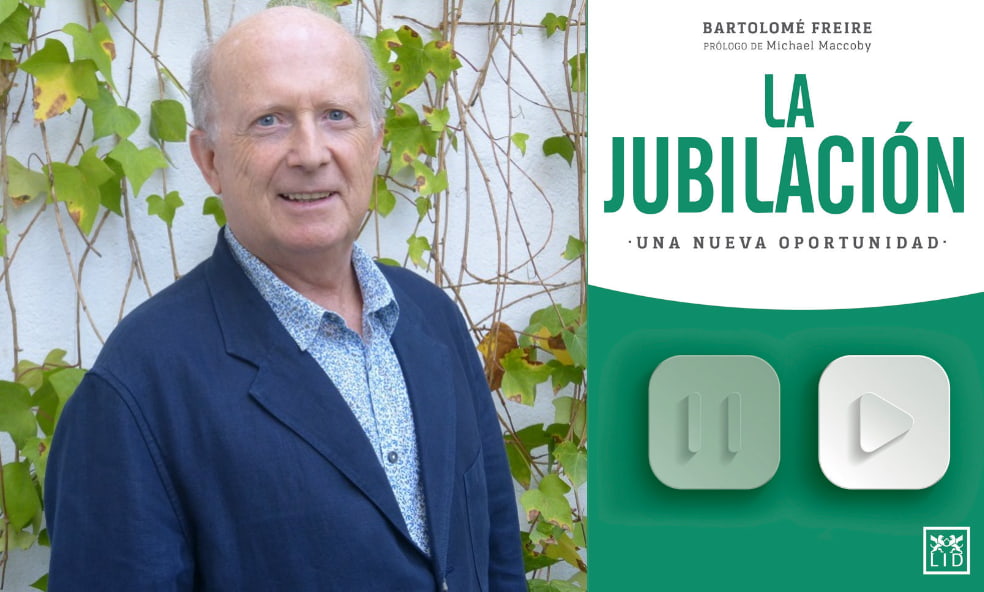
A BRIEF SUMMARY OF THE BOOK “La Jubilación, una nueva oportunidad”
(Retirement, a New Opportunity) (LID editorial, Madrid 2017).
By: Bartolomé Freire, M.D., Ph.D.
Retirement is that stretch of life which begins with the end of paid working life up to the time when one’s capacities become severely limited by advanced age. In Spanish this period is called Jubilación, or jubilation. The word suggests a time of celebration and freedom. This implies a cultural difference with the English word retirement, where the focus is not on the future of enjoyment, but on the past from which one is retiring
This book explains the five major ways people adapt to their retirement. The findings come from a socio-psychoanalytic study of 150 people interviewed in the Madrid area. The male and female interviewees come from many walks of life, and various types of former work.
The book initially describes the experience of separating from work and making the transition into retirement. This involves the grieving process, the different roads taken to retirement and the initial emotions and reactions. This is followed by a discussion of the challenges a recent retiree faces. These include what might be called ‘an update’ of his or her personal identity, the finding of meaningful tasks and a new structure for his or her days, renegotiating previous conscious and sometimes unconscious agreements with spouse and relatives, etc..
The responses of the interviewed retirees are quoted and analyzed. The psychological skills which promote a productive adaptation to retirement are described.
The Research
In the second part of the book the research results on which the book is based are presented and discussed. The goal was to find out how retired persons adapt to the changes introduced in their lives by retirement. Ninety three men and 57 women retirees were interviewed as the core of the research. Each shared their life’s vision, which included the trajectory of their past up to their current situation.
The retirees vividly conveyed their intentions, fears and successes. Many of their insights about themselves are included in the book. A main goal of the research was to identify the basic motivation of each interviewee, that which guided their adaptive efforts. In the book, their adaptive strategies are called “orientations”.
Five different orientations were found: Task Doers, Leisure Seekers, Searchers for Calm, Explorers and Out of focus.
- TASK DOERS (29.3%): This group keeps on working after retirement, or finds other tasks which become important in this new life period. Their new responsibilities provide structure and meaning to their lives and/or preserve their identities.
This orientation was more common among men who had rewarding jobs. - LEISURE SEEKERS (35.3%): This freely enjoys all the activity and recreation options that retirement makes possible. They tend to put aside fixed commitments and time tables, and like to improvise.
More women followed this orientation. Many of them claimed they were compensating for the past overload of combining work with being a housewife and mother. - SEARCHERS FOR CALM (9.3%): This group’s priority is to have a relaxing retirement, and take advantage of what is already available to them. They center their lives around their homes and only rarely set themselves new goals.
A majority of this group decided to retire before they turned 65. They were tired of working and/or wished to be rid of an ungrateful boss or troubled job where they were felt not valued. - EXPLORERS (10,6%): This group faces retirement as an opportunity to expand their horizons or renew themselves. They are oriented to learn something new or something they did not develop fully in the past, including aspects of themselves.
There were more women among them than men. Many said they hoped to develop themselves, after so many years of dedication to others. - OUT OF FOCUS (15,3%): This group does not set up or maintain meaningful retirement projects. They either have difficulties defining their goals or they have trouble finding the energy to achieve them. They express doubts or dissatisfaction with their current life and/or reproach themselves they are not exercising their abilities.
There was a higher rate of compulsory early retirement among the men in this orientation.
The book gives a detailed description of each of these orientations. Then comes an evaluation of the productive and unproductive aspects of each one of them. All are illustrated with the cases of the interviewed retirees. The reader gains pictures of the real people behind the concepts.
Five questions are then raised to encourage retired readers to assess their own adaptive solutions. Finally, based on the knowledge gained from the research, some further issues are addressed, such as gender differences, and how adaptation to retirement evolves with age.

No Comments